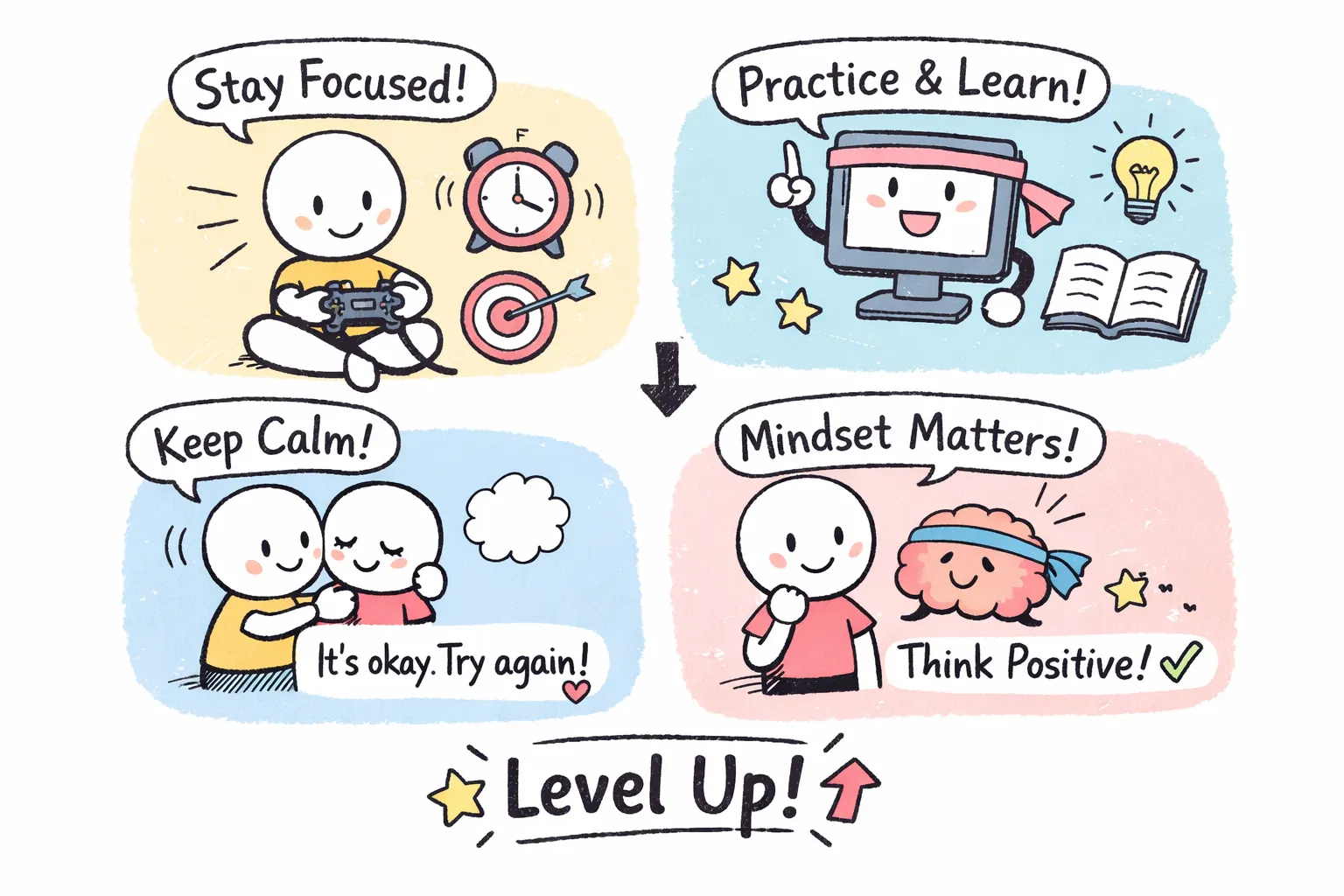
If you’ve ever wondered what the best mental strategies to get better at video games actually look like in practice, the answer isn’t more hours at the keyboard. Most gamers hit a wall not because their hands are slow, but because their mind is working against them. They grind hundreds of hours and still make the same mistakes, lose focus in crunch moments, or spiral after a bad round. The fix is smarter mental training.
The mental game is a real, trainable skill set, and it’s the most overlooked part of competitive improvement. Whether you play FPS, MOBA, or strategy games, applying the right cognitive and psychological tools will change how you perform starting this week. At GameSkill Hub, we cover exactly this intersection of mindset and tactical skill-building because one without the other only gets you so far.
This article gives you a concrete set of mental routines: focus drills, tilt-management systems, deliberate practice frameworks, and recovery habits, plus a session template you can use immediately.
Why mechanics alone won’t make you better
Pro esports players don’t just train their hands. They train four core cognitive skills: attention, working memory, reaction time, and decision-making. EEG studies on experienced players show measurably higher beta wave activity during play, which is directly linked to concentration and information processing. MOBA players in particular demonstrate superior working memory, holding and manipulating enemy positions and strategy variables in real time while under pressure. (A study reveals cognitive gains from competitive gaming.)
These aren’t fixed traits you either have or don’t. They’re trainable capacities that improve with the right approach. The reason most players plateau isn’t a lack of talent; it’s that they repeat the same patterns without targeting the specific cognitive pathway that needs work.
Casual repetition and deliberate mental engagement are not the same thing. Playing a hundred more ranked matches builds habit, not necessarily skill. Focused, goal-directed practice triggers myelin reinforcement, the process that actually speeds up neural pathways and locks in improvement. The sections below show you exactly how to put that into practice.
Focus drills that sharpen your in-game attention
Pre-session breathing and priming
Your mental state before you queue matters more than most players realize. Diaphragmatic breathing, practiced for just 3 to 5 minutes before a session, measurably reduces the scattered thinking and low-grade anxiety that tanks early-game decision-making (see breathwork protocols for health, focus, and stress). Clinical reports on breathing drills like the Fist Pumping technique (rapid open-close fists at shoulder height with energizing breaths) show 20 to 25% gains in attention span from short daily sessions. A calm, oxygenated brain processes faster and makes cleaner calls under pressure.
Visualization is another tool that elite esports players and traditional athletes use before performance. Spend two minutes with your eyes closed and mentally walk through your game’s opening sequence, your first rotation, or a specific skill scenario you want to execute well. This primes the motor pathways involved in that skill and reduces early-match hesitation. It works for the same neurological reasons athletes across every discipline use it.
Protecting focus during longer sessions
Longer sessions introduce a different problem: attention decrement that sets in when you grind for hours without pause. The Pomodoro method applied to gaming means 25-minute focused play blocks followed by a 2-minute physical break. Use this structure during deliberate practice blocks rather than ranked queues, and you’ll notice sharper decision-making in the second and third blocks compared to an unbroken two-hour grind.
Tilt control: staying composed when matches go sideways
Recognizing tilt before it compounds
Tilt is emotional escalation that degrades decision-making. You know you’re tilting when you start making reckless plays, your awareness narrows to the player who just killed you, or you feel physical tension creeping into your shoulders and jaw. Catching those signs early is the foundation of every other technique in this section because no reset strategy works if you’re already deep in a spiral.
Esports psychology research, including studies examining stress response patterns in competitive players, shows that experienced players tilt less severely because accumulated experience moderates how they interpret setbacks. Players who believe tilt is a changeable state also respond more constructively than those who treat it as fixed. That mindset shift alone is actionable: you can change how you handle frustration, and believing that is the first step.
In-match reset tools
For in-match resets, several evidence-based tools work quickly. During a loading screen, run a 4-2-4 breathing cycle (inhale 4 seconds, hold 2, exhale 4). Use a cue word like “next” to deliberately redirect attention away from the last mistake. Roll your shoulders, take a sip of water, and reset your posture. These micro-resets aren’t filler, shifting your attentional focus between rounds is a validated emotion-regulation strategy that prevents frustration from compounding into a full tilt spiral.
After a rough match, replace “why is this game unfair?” with a more useful question: “What was the one decision that hurt me most?” That reframe turns a loss into a data point. Players who treat every match as a learning session rather than a performance verdict build resilience faster and improve more consistently over time.
Deliberate practice: mental strategies for improving at video games through structured training
The single-goal rule
Unfocused play builds bad habits. Every session needs a defined goal before you start. Not “play better” but something specific: improve reaction to enemy flanks, tighten crosshair placement on moving targets, or work on map rotation timing. This single-goal rule directs myelin reinforcement into the exact neural pathway that needs strengthening. It works across every genre, FPS, MOBA, RTS, and it’s what separates players who improve from players who just accumulate hours. This aligns with broader deliberate practice theory about focused, feedback-driven training.
The three-phase session structure
Structure each session in three phases. Warm up for 10 to 15 minutes in a low-stakes mode or aim trainer to get your hands and mind synchronized before you ask them to perform. Then run a 25 to 30-minute focused block on your session goal, whether that’s isolated mechanics training or targeted in-game practice. Finally, spend 5 to 10 minutes on review: watch footage or mentally replay the moments where the skill broke down.
That review phase is where most players drop the ball. It’s also where the real improvement lives. Identifying the exact moment a decision failed, and understanding why, builds the feedback loop that deliberate practice requires. GameSkill Hub’s game-specific skill guides are built around this framework, giving you drill structures and review prompts for your specific game so you’re not building the system from scratch.
Physical habits that quietly power your mental performance
Sleep is the fastest reaction-time upgrade available and it costs nothing. Research on competitive athletes shows that sleep extension above 10 hours per night across a two-week period produced measurable improvements in reaction time on psychomotor vigilance tasks (see sleep extension research). On the flip side, a single night of sleep deprivation slows mean reaction time by roughly 50 milliseconds in esports players (the effect of total sleep deprivation on cognitive and in-game performance). In a game with a 150 to 200 millisecond reaction window, that’s a 25 to 33% performance loss before the match even starts.
Consistent 8 to 9 hours matters more than one good night before a tournament. Think of it this way: gaming in a sleep-deprived state is practicing with a handicap on your decision-making. You’re not building skill; you’re reinforcing slower, sloppier patterns that become harder to undo.
Nutrition has a smaller but real effect on in-session sharpness. A peer-reviewed crossover trial found that 3 mg/kg of caffeine taken one hour before play improved reaction time, visual search speed, and shooting accuracy in esports players. Mild dehydration impairs working memory and concentration, so consistent hydration during sessions is a baseline, not a bonus. Creatine shows limited but promising evidence for buffering the cognitive cost of poor sleep nights. These aren’t replacements for sleep and deliberate practice; they’re small multipliers on top of a solid routine.
Putting it all together: your mental game routine
Here is a session template you can start using this week. It doesn’t require extra hours; it replaces aimless queuing with structured work.
- Pre-session (5 minutes): 3 minutes of diaphragmatic or box breathing, followed by a 2-minute visualization of your opening sequence or target skill
- Warm-up (10 to 15 minutes): Low-stakes play or aim training to sync hands and mind
- Main block (25 minutes): Focused practice with one defined session goal (Pomodoro chunk)Physical break (5 minutes): Water, stretch, breathe, step away from the screen
- Optional second block (25 minutes): Repeat the main block with the same or a connected goal
- Post-session review (5 to 10 minutes): Mental replay or footage review targeting the one moment the skill broke down
Pair this template with a simple session log. Write down your goal for the session, one moment where the mental strategy worked, and one where it didn’t. Tracking consistency matters more than tracking results. Wins are a lagging indicator; mental habits are the leading indicators that produce wins weeks from now. That mindset shift separates players who keep climbing from players who stay stuck.
If you want deeper guidance on applying this system to a specific game, GameSkill Hub has structured mindset guides and game-specific skill content designed for players who are serious about building this kind of practice routine.
Pick one technique and start this week
So what are the best mental strategies to get better at video games? The honest answer is that there’s no single trick. Better performance comes from training with intention across four areas: focus, tilt control, deliberate practice, and physical recovery. The tools in this article are what separate players who plateau from players who keep climbing.
Don’t try to implement everything at once. Pick one technique from each section, run the session template above for a week, and track what changes. That mental side of gaming is entirely learnable, and you now have the blueprint. The only variable left is whether you actually use it.