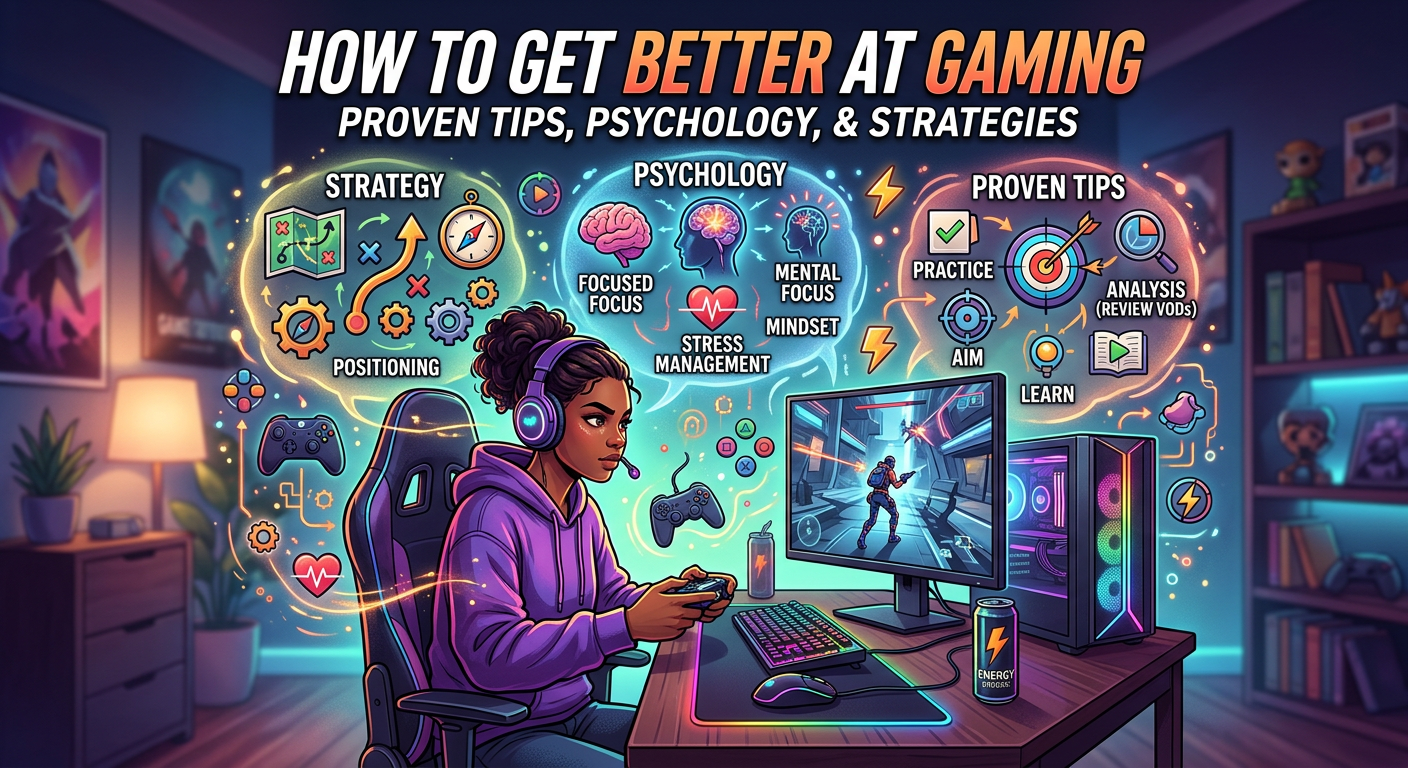
Let me ask you something. Have you ever felt like you are putting in hours every day but still getting destroyed by players who seem half as dedicated as you? You are not alone. Millions of gamers deal with this exact frustration. The good news? Getting better at gaming is not some mysterious gift that only a few people are born with. It is a skill. And like any skill, it can be learned, trained, and improved with the right approach.
This article is going to break it all down for you. Real tips. Real psychology. Real strategies that actually work.
Why Most Gamers Stay Stuck at the Same Level
Here is the hard truth. Most gamers never improve because they keep doing the same thing over and over and expect different results. They log on, play five matches, rage a little, close the game, and repeat. That cycle? It goes nowhere.
Improvement does not come from just playing more. It comes from playing smarter. There is a massive difference between spending ten hours grinding ranked and spending two hours intentionally working on one specific weakness.
The players who get good fast are not grinding harder. They are thinking differently.
The Mindset Shift That Changes Everything
Before we even talk about mechanics or settings or strategies, we need to talk about your head. Because your brain is the most powerful tool you have, and most people are using it against themselves.
Stop Playing to Win, Start Playing to Learn
This sounds counterintuitive, right? You play games to win. But when winning becomes your only goal, every loss feels like a personal failure. That emotional response shuts down your ability to learn from what just happened.
Instead, shift your focus. Ask yourself after every match: What did I do wrong? What could I have done better? What did my opponent do that I did not see coming?
When you start treating every game as a lesson instead of a verdict on your worth as a player, progress happens naturally.
How Ego Kills Your Progress
Nobody wants to admit they are bad at something. But ego is one of the sneakiest barriers to improvement. When you believe you already know enough, you stop paying attention to the things you need to fix. You blame your teammates. You blame lag. You blame everything except the decisions you made.
Drop the ego. Be a student. The best players in the world still study, still take coaching, still analyze their mistakes. If they can do it, so can you.
Understanding Your Current Skill Level
You cannot get from point A to point B if you do not know where point A is. This is why honest self-assessment is so important.
Honest Self-Assessment
Watch your own gameplay back. Record your sessions and look at them with fresh eyes. You will notice things you never saw in the moment. Maybe your positioning is consistently off. Maybe you panic when the enemy pushes. Maybe your decision-making slows down under pressure.
Most people hate watching themselves play because it is uncomfortable. That discomfort is exactly where growth lives.
Track Your Mistakes, Not Just Your Wins
Keep a simple notes document. After each session, write down two or three specific mistakes you made. Not “I played badly.” Something concrete, like “I overextended when I was low on health” or “I kept forgetting to check the minimap.”
Over time, patterns emerge. And patterns can be fixed.
The Science Behind Getting Good at Games
There is actual neuroscience behind skill development. This is not just motivational talk. Your brain physically changes when you practice.
Muscle Memory and Why It Matters
Muscle memory is not really in your muscles. It is in your brain. When you repeat an action enough times, your brain creates pathways that make that action automatic. Think about how you type without looking at the keyboard. That is muscle memory.
In gaming, this applies to keybinds, aim, movement, and reaction time. The more you repeat correct actions, the more natural they become. Which is why practicing bad habits is so dangerous. You are literally training your brain to make mistakes automatically.
How Your Brain Learns New Skills
Learning happens in stages. First, everything feels awkward and deliberate. Then it gets slightly more natural. Then eventually it becomes effortless. This process takes time and cannot be rushed, but it can be accelerated with proper practice methods.
Sleep is also part of learning. Your brain consolidates skills during deep sleep. This is why getting enough rest is not optional if you want to improve fast.
Practice the Right Way
Not all practice is equal. Sitting down with zero intention and just playing is fun, but it is not the same as deliberate practice.
Deliberate Practice vs. Casual Play
Deliberate practice means you identify one specific skill and focus on improving only that for a set period. Maybe it is your aim. Maybe it is your map awareness. Maybe it is how you manage resources in a strategy game.
You isolate the weakness. You drill it. You get uncomfortable. That discomfort means you are growing.
Casual play has its place. It keeps gaming fun. But if improvement is the goal, deliberate practice needs to be part of your routine.
The 20-Minute Focused Session Rule
Try this. Before you start your regular gaming session, spend twenty minutes on one specific skill. Use aim trainers. Play a custom lobby. Watch one video on a specific mechanic and then immediately try to apply it.
Twenty focused minutes beat two unfocused hours. Every single time.
Want to get Honeycomb in Minecraft Without Angering Bees? Here is a full guide on how to Get Honeycomb in Minecraft Without Angering Bees (Step-by-Step Guide).
Study the Game Like a Student
The best athletes in the world watch game tape. Gamers should do the same.
Watch Replays and Learn From Them
Most modern games have a replay system built in. Use it. After a tough loss, watch the replay from the perspective of the player who beat you. Try to understand what they saw that you missed. Try to understand why their decision worked and yours did not.
This is one of the fastest ways to learn that most casual players never use.
Learn From Pro Players Without Copying Them Blindly
Watching pro streamers and tournament play is valuable. But here is the catch. Pro players operate at a level where they can execute options that would get a lower-ranked player destroyed. Do not copy a pro move that requires skills you have not built yet.
Instead, focus on the thinking behind their decisions. Why did they rotate there? Why did they not take that fight? The reasoning matters more than the action.
Master the Basics Before Anything Else
This is the one thing most people skip. They want to learn the fancy stuff before they have locked in the fundamentals. That is like trying to learn calculus before you understand multiplication.
Whatever game you play, identify the five most basic mechanical skills and make sure they are rock solid. Aim. Movement. Resource management. Communication. Game sense. Everything you learn will be built on top of these foundations.
If your foundation is shaky, nothing above it will hold.
Settings, Gear, and Environment Matter More Than You Think
Okay, let us talk about your setup. Because your environment affects your performance more than most people realize.
Optimize Your Setup
Your sensitivity settings should feel completely natural. If you have to think about your mouse movement, it is either too fast or too slow. Frame rate matters in fast games. Input lag matters. Your chair posture affects how long you can focus before fatigue sets in.
Go through your settings and actually think about each one. Do not just use defaults. Customize them to match your playstyle.
Does Expensive Gear Make You Better?
Here is an honest answer. A little. A high refresh rate monitor gives you a genuine advantage in fast-paced games. A good mouse with low latency helps. But no piece of gear will compensate for poor fundamentals.
Spend money on gear only after you have invested in your actual skills. Otherwise, you are just buying expensive ways to lose.
The Psychology of Losing and How to Handle It
Losing is part of gaming. Every single player you look up to has lost thousands of times. The difference is how they respond to it.
Tilt Is Your Biggest Enemy
Tilt is what happens when frustration starts controlling your decisions instead of logic. You start playing recklessly. You take fights you should not take. You stop communicating. You blame everything around you.
Tilt is the silent killer of improvement because when you are tilted, you are not learning. You are just reacting emotionally.
Simple Ways to Manage Tilt
First, recognize when it is happening. Your chest feels tight. Your decisions get faster and sloppier. You start typing angry messages.
When you notice those signs, take a break. Five minutes away from the screen can reset your mental state completely. Drink some water. Take a few deep breaths. Come back only when you feel calm.
Set a loss limit, too. Decide before you play that if you lose three matches in a row, you stop for the day. This saves you from the doom spiral of tilted play.
Communication and Teamwork in Multiplayer Games
If you play team-based games, communication is a skill on its own. Bad communication can throw a winnable game. Good communication can make a struggling team competitive.
Keep callouts clear and short. “Enemy pushing left” is better than a thirty-second story about how they got you. Stay positive even when things go badly. Positive teams tend to play better because morale affects decision-making.
And sometimes? The best thing you can do is say nothing at all and just play your role correctly.
Physical Health and Gaming Performance
This part gets ignored constantly. But your body runs your brain, and your brain runs your gameplay.
Sleep, Food, and Your Reaction Time
Studies have shown that being sleep-deprived slows your reaction time as much as being drunk. If you are staying up until three in the morning to grind ranked, you are not playing your best game. You are playing a handicapped version of yourself.
Eat real food during sessions. Sugar crashes are real, and they affect your focus in the middle of a match.
Hand and Eye Exercises for Gamers
Your hands take a beating during long sessions. Stretching your fingers and wrists regularly reduces injury risk and keeps your movement precise. Eye strain is also real. Follow the 20-20-20 rule. Every twenty minutes, look at something twenty feet away for twenty seconds. Your eyes will thank you, and your focus will stay sharper longer.
Finding the Right Community
Who you play with shapes how fast you grow. Playing with people who are slightly better than you forces you to level up. Playing with people who are constantly negative or toxic drains your energy and slows your progress.
Find a community of players who take improvement seriously. Discord servers, subreddits, and local gaming groups. Surround yourself with people who push you forward, not drag you back.
Set Goals the Smart Way
Vague goals do not work. “Get better” is not a goal. It is a wish.
Specific goals work. “Improve my headshot accuracy by five percent this week.” “Learn two new map callouts before the weekend.” “Win sixty percent of my duels instead of fifty.” These are measurable. You can track them. You can celebrate when you hit them.
Small wins compound into massive progress over time. That is not motivational fluff. That is just how skill development works.
Consistency Beats Talent Every Single Time
Here is something that should give you hope. Natural talent matters a lot less than people think. Consistent, intentional effort over time beats raw talent in almost every case.
The players who climb the highest are rarely the ones who were gifted from the start. They are the ones who showed up every day, stayed curious, stayed humble, and kept working even when progress felt invisible.
You do not need to be a prodigy. You just need to be consistent and deliberate.
In the final analysis
To get better at gaming, it’s not about how many hours you play, but how you use that time. The key is to play with the right focus and a strong mindset.
Start by getting your head in the game. Be honest with yourself about your current skills, and when you practice, do it with a specific goal in mind. Remember to take care of your health, find good people to play with, and set clear goals for your improvement.
Do all of that, and improvement is not just possible. It is inevitable. The gap between where you are and where you want to be is not talent. It is just work you have not done yet. So go do the work.
FAQs
1. How long does it take to get noticeably better at a game?
With intentional practice, most players notice meaningful improvement within two to four weeks. Big skill jumps usually come after a few months of consistent, focused effort.
2. Is it worth hiring a gaming coach?
Absolutely, if you are serious about improvement. A good coach spots bad habits that you cannot see yourself and gives you a structured path forward. It is not just for pros.
3. Should I focus on one game or play multiple games at once?
If improvement is your main goal, focus on one game at a time. Spreading your attention across multiple titles slows down the skill-building process significantly.
4. How do I stop getting so angry when I lose?
Start by setting a loss limit before each session. Remind yourself that losing is data, not failure. Over time, reframing losses as learning opportunities genuinely reduces the emotional sting.
5. Does playing for more hours always mean getting better faster?
No. Quality beats quantity every time. Two hours of focused, deliberate practice will improve you faster than eight hours of mindless grinding. More time with no intention is just more time doing the same thing wrong.
6 thoughts on “How to Get Better at Gaming: Proven Tips, Psychology, and Strategies”