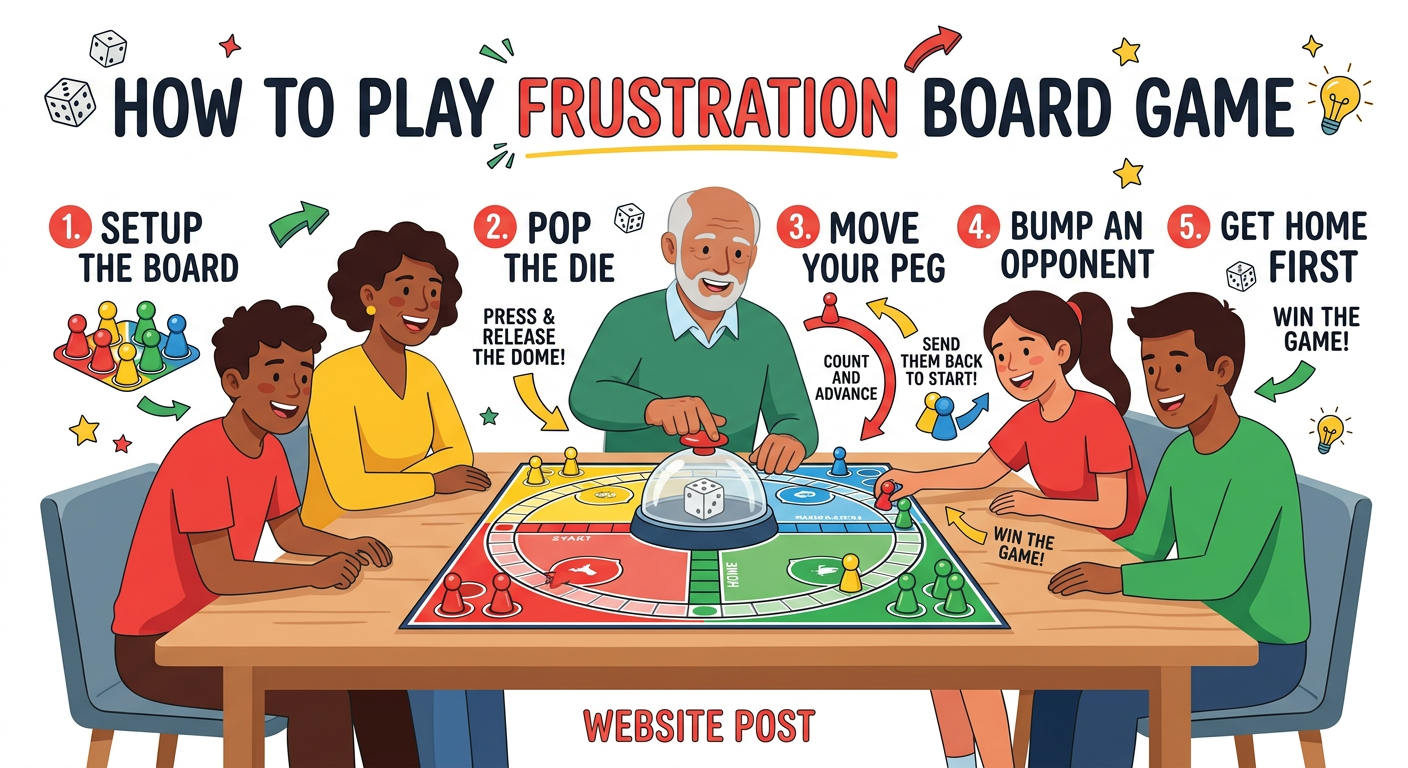
Ever sat around a table with family, everyone laughing and shouting — and then someone lands on your piece and sends it all the way back to the start? That is Frustration in a nutshell. It is one of those classic board games that has been around for decades and still gets people fired up every single time.
If you just picked up the frustration board game and have no idea where to start, do not worry. This guide walks you through everything — setup, rules, tips, and all the little things that make this game so addictive.
Let us get into it.
What Is the Frustration Board Game?
Frustration is a classic family board game made by Hasbro. The goal is simple — move all four of your pegs around the board and get them home before anyone else does.
Sounds easy, right? Not quite.
Other players can land on your pegs and send them back to the start. That is where the name comes from. Just when you think you are winning, someone ruins everything. It is chaotic, funny, and incredibly competitive all at once.
The frustration board game has been a household favourite since the 1960s. It is simple enough for kids but entertaining enough for adults. Whether you call it a frustration board game or just “that game that ruins friendships,” it delivers every time.
What Comes Inside the Frustration Box?
Before you start playing, let us check what is in the box:
- 1 game board with a track running around the outside
- 4 sets of colored pegs (usually red, blue, yellow, and green — 4 pegs each)
- 1 Popomatic bubble built into the center of the board (this is the dice roller)
- Frustration board game instructions sheet
That is it. No cards. No extra pieces. Everything you need is right there.
How to Set Up the Frustration Board Game
Setup is quick. Takes about two minutes.
Setting Up the Board
Place the board flat on a table where everyone can reach it comfortably. The Popomatic bubble sits in the center — that is your dice. No separate dice to lose.
Choosing Your Color
Each player picks a color. You get 4 pegs in that color. Red, blue, yellow, green — pick what you like. Does not affect gameplay at all.
Starting Positions
All 4 of your pegs start in your home base. That is the colored circle in your corner of the board. Nobody moves until the game starts. Simple.
Decide who goes first. You can just press the Popomatic bubble, and whoever rolls the highest goes first. Then the play goes clockwise around the table.
Frustration Board Game Rules (Full Breakdown)
This is the important part. The frustration board game rules are straightforward, but you need to know them properly, or arguments will happen. Trust me.
How to Get Your Pegs Out
Your pegs start in your home base. To move a peg onto the board, you need to roll a 6.
Roll a 6 → place one peg on your start square → roll again (you get a bonus roll for rolling 6).
If you do not roll a 6, you cannot move any peg out. Your turn ends, and you pass to the next player.
This is the first frustrating part of the game. Sometimes you sit there for three or four turns without rolling a 6 while everyone else is already moving. That is just how it goes.
Moving Around the Board
Once your peg is on the board, you move it the number shown on the dice. You go clockwise around the outer track.
A few key things to remember:
- You must move if you can. You cannot skip your turn on purpose
- If you roll a 6, you move 6 spaces AND get another roll
- You keep getting bonus rolls every time you roll a 6
- If you roll three 6s in a row, your turn ends immediately, and you get no moves — a house rule in many families, but check your frustration board game instructions.
Landing on Other Players
This is the best and worst part of the game.
If you land on a square that already has another player’s peg, that peg goes back to their home base. They have to start again. From scratch.
Imagine your peg is almost home. One or two squares away. Then someone lands on you. Back to the start. That is why the game is called Frustration.
You cannot land on your own pegs. If your peg would land on one of your own pieces, you just stack them on the same square, and both move together.
The Safe Zones
Each color has a colored home column — a short track that leads to the finish. This is the safe zone. Once your peg enters this column, no one can knock it back. You are safe.
To enter your home column, your peg must travel all the way around the board and reach your entry point. Then you move up the column toward the finish.
You need an exact number to land on each finish square. If you roll too high, you cannot move that peg. You either move a different peg or wait for the right number.
How to Win the Game
First player to get all 4 pegs into their home column finishes squares wins.
Simple as that. But getting all four there is harder than it sounds because people keep knocking you back.
The finish squares in the home column are numbered. You need exact rolls to fill them. So the end of the game can take longer than expected when you keep rolling the wrong numbers.
The Popomatic Bubble — What Is It and How Does It Work?
The Popomatic bubble is one of the most satisfying things about this game. It is a clear plastic dome in the center of the board. Underneath it sits a single die.
You press the bubble down with your palm. It pops back up, and the die rolls inside. That is it.
No more dice flying off the table. No more “I rolled a 6, I swear.” The bubble keeps everything fair and contained. Kids absolutely love pressing it.
Press it firmly and listen for the pop. Whatever number shows on the die — that is your roll.
Frustration Card Game — Is It Different?
Yes. The frustration card game is a completely separate game. It has nothing to do with the frustration board game.
The frustration card game is a matching card game. Players try to collect sets of cards. When someone completes a set, they shout “Frustration,” and the round ends.
It is a fun card game on its own. But it is not the same as the board game. Do not confuse the two. If someone says, “Let us play Frustration,” make sure everyone is talking about the same game.
This article is about the frustration board game — the one with pegs, a board, and the Popomatic bubble.
Common Mistakes Beginners Make
These trip people up all the time:
Mistake 1: Not knowing you must roll a 6 to start
A lot of new players try to move a peg on any number. You cannot. Roll a 6, or you stay at home base.
Mistake 2: Forgetting the bonus roll
Roll a 6, and you get another turn. Many beginners forget this and pass the bubble to the next player.
Mistake 3: Entering the home column too early
You must go all the way around the board first. You cannot shortcut into your home column from the wrong direction.
Mistake 4: Not using exact numbers in the home column
You need exact rolls to place pegs in the finish squares. If you overshoot, you cannot move that peg. Many beginners keep trying to force it.
Mistake 5: Landing on your own pegs by mistake
Your own pegs stack together. Other players’ pegs get sent home. Know the difference.
Tips and Tricks to Win at Frustration
Want to actually win this game? Here are some practical tips:
Always get pegs out early
The more pegs you have on the board, the more options you have each turn. Do not keep all your pegs in home base waiting for the perfect moment.
Target the player closest to winning.
If someone has three pegs almost home, focus on knocking them back. Do not ignore the leader.
Keep one peg back as a spare.
If most of your pegs are far around the board, keep one back near the start. That way, if your front pegs get knocked back, you have not lost all your progress.
Use the 6 bonus rolls wisely.
When you roll a 6, think before you move. Do you bring a new peg out or advance an existing one? Choose based on where everyone else is on the board.
Count squares ahead
Before you move, look at where your peg will land. Will you land on an opponent? Will you be in a dangerous spot where someone can knock you back? Think one step ahead.
How Long Does a Game of Frustration Take?
A typical game of Frustration takes around 30 to 45 minutes with 4 players.
It can go faster if someone gets lucky with rolls. It can drag on if people keep getting knocked back. Either way, it rarely goes over an hour.
With 2 players, it goes much faster — usually 15 to 20 minutes. Great for a quick game.
How Many Players Can Play Frustration?
The frustration board game is designed for 2 to 4 players.
Four players are the most fun because there is more chaos. More people to knock back. More drama. More actual frustration.
Two players work fine, but it is a bit less exciting. Three players is a good middle ground.
You cannot play with more than 4 because the board only has 4 color zones.
Is Frustration Good for Kids?
Yes absolutely. Frustration is one of the best family board games for kids aged 5 and up.
Here is why it works well for kids:
- The rules are simple and easy to explain
- The Popomatic bubble is fun to press — kids love it
- No reading required
- Games do not take too long
- It teaches taking turns and handling losing gracefully
The only downside — younger kids can get genuinely upset when their peg gets knocked back. Be ready for some real frustration from the little ones. That is kind of the point, though.
Frustration vs Ludo — What Is the Difference?
A lot of people ask this. They look very similar.
| Feature | Frustration | Ludo |
|---|---|---|
| Dice method | Popomatic bubble | Regular dice |
| Pegs per player | 4 | 4 |
| Board shape | Similar cross shape | Cross shape |
| Knocking back | Yes | Yes |
| Safe zones | Yes | Yes |
| Origin | Hasbro (UK/US) | Traditional Indian game |
The biggest difference is the Popomatic bubble. Ludo uses regular dice. Frustration also has a slightly different board layout and track design.
Both games follow very similar core rules. If you know how to play one, you can pick up the other pretty quickly.
Frustration feels a bit more modern and polished. Ludo has a more traditional feel. Both are great family games.
Conclusion
Frustration is one of those games that never gets old. Simple rules. Fast setup. And just enough chaos to keep everyone on edge. Whether you are playing with kids, family, or friends, it always delivers laughs and a few groans.
Now you know the full frustration board game rules, how to set it up, and some tips to actually win. So grab the box, press that Popomatic bubble, and may your pegs never get knocked back.
Good luck. You are going to need it.
FAQs
1. Do you have to roll a 6 to start in Frustration?
Yes. You must roll a 6 to move any peg out of your home base onto the board. If you do not roll a 6, your turn ends and you pass to the next player.
2. What happens if you roll three 6s in a row in Frustration?
In the official frustration board game rules, your turn simply continues. But many families play a house rule where three 6s in a row end your turn with no moves. Check your specific frustration board game instructions to confirm.
3. Can you have more than one peg on the same square in Frustration?
Yes, but only your own pegs. If two of your pegs land on the same square, they stack and move together. You cannot stack on an opponent’s peg — you knock it back instead.
4. Is the Frustration board game the same as the Frustration card game?
No. They are completely different games. The frustration board game uses pegs and a board with a Popomatic bubble. The frustration card game is a matching card game where players collect sets of cards.
What age is the Frustration board game suitable for?
The frustration board game is recommended for ages 5 and up. It is simple enough for young children but entertaining enough for adults. It works best with 3 or 4 players for maximum fun.