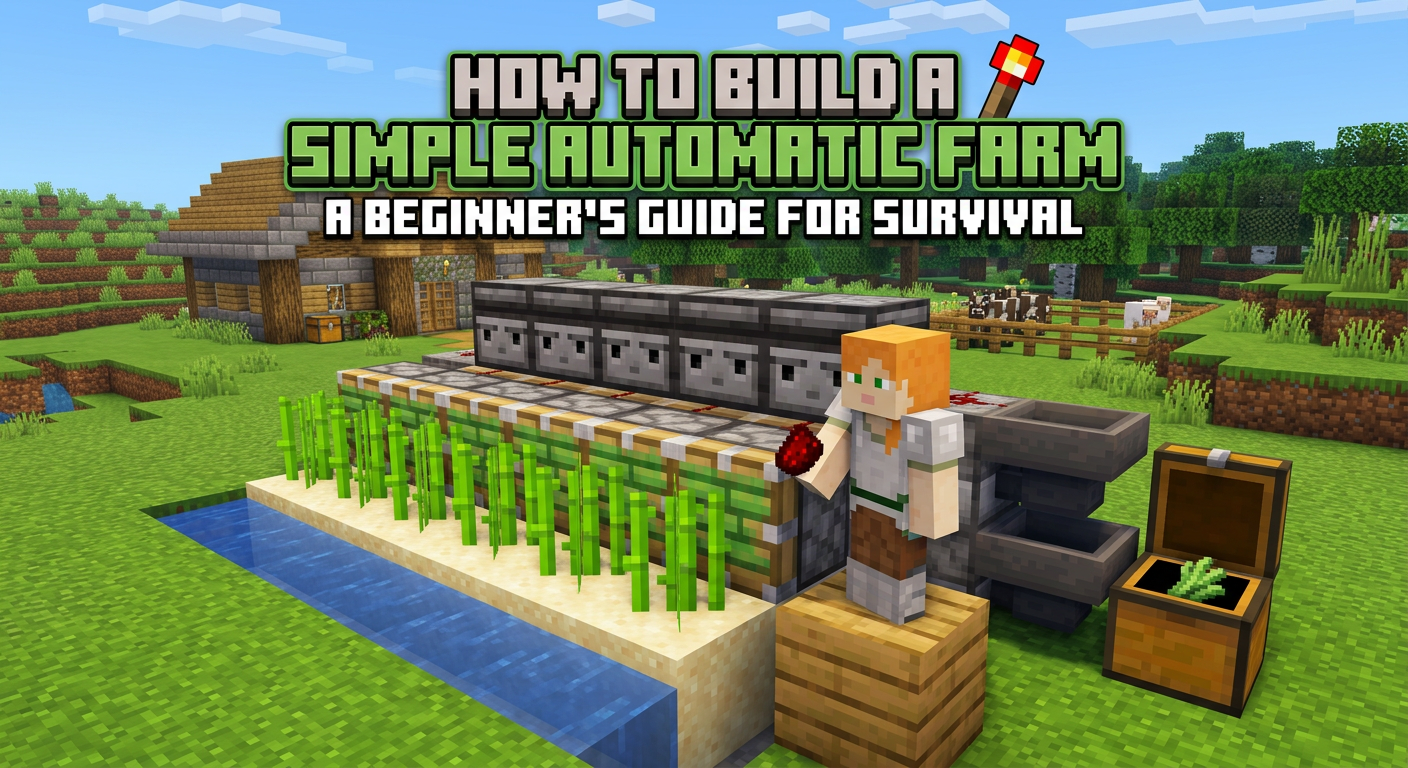
Let me guess. You are tired of manually breaking crops every single time you need food. You want something that just works on its own while you go do other things. That is exactly what automatic farms are for.
Automatic farms in Minecraft are like setting up a machine and walking away. It does the work. You collect the results. Once you build one, you will never want to go back to farming by hand.
This guide covers everything — water farms, villager farms, animal farms, and simple builds that work on both Java and Bedrock Edition. No complicated redstone. No confusing setups. Just straight builds that actually work.
Let us get into it.
What Is an Automatic Farm in Minecraft?
An automatic farm is a setup that collects resources for you without you doing much work. Some farms are fully automatic — they grow and collect on their own. Others are semi-automatic — you trigger them, but collection is handled for you.
Think of it like a conveyor belt at a factory. You set it up once, and it keeps producing. Whether you want food, sugarcane, bamboo, or mob drops, there is an auto farm for everything.
For beginners, the best starting farms are:
- Water crop farms — for wheat, carrots, potatoes
- Sugarcane farms — easy and very useful
- Villager farms — powerful but need more setup
- Animal farms — for meat and resources
Why Build an Automatic Farm?
Because manually farming is slow and boring. Simple as that.
Here is what you get from auto farms:
- Constant food supply without lifting a finger
- More time to explore, build, and fight
- Stacks of resources are building up while you are busy
- Less grinding and more actually enjoying the game
Once you have a good farm running in the background, Minecraft becomes a completely different experience. You stop worrying about food and resources and start focusing on the fun stuff.
What You Need Before You Start
Before building anything, gather these basic materials:
- Dirt or farmland blocks — for growing crops
- Water buckets — at least 1 or 2
- Seeds — wheat seeds, carrot, potato, or sugarcane
- Chest — to store collected items
- Hopper — connects to the chest and collects items automatically
- Basic building blocks — wood, stone, anything works
- How to till dirt into farmland
For more advanced farms, you will also need:
- Redstone dust and repeaters
- Pistons
- Observer blocks
- Dispensers
Do not worry if you do not have all of this yet. Start simple and upgrade later.
How to Make an Automatic Farm in Minecraft with Water
A water farm is the most beginner-friendly automatic farm in Minecraft. Water flows over crops and pushes them into a collection point. Super simple.
Step-by-Step Water Farm Build
Here is how to build a basic water crop farm:
Step 1 — Dig your plot
Dig a flat area 9 blocks wide and as long as you want. Standard size is 9×9.
Step 2 — Till the dirt
Use a hoe to till all the dirt blocks into farmland. Every block needs to be tilled before planting.
Step 3 — Add a water source
Leave one block at the end of each row until. Dig it one block down and place water there. Water reaches 4 blocks in each direction, so one water source covers 8 blocks of farmland perfectly.
Step 4 — Plant your seeds.
Plant wheat seeds, carrots, or potatoes on every farmland block. Make sure the farmland stays wet — it should turn dark brown when water is nearby.
Step 5 — Add collection system
At one end of your farm, dig a trench one block deep. Place a hopper at the lowest point and connect it to a chest. When crops break, they flow into the trench and get sucked into the hopper and chest.
Step 6 — Add a water dispenser (optional)
For a fully automatic harvest, place a dispenser filled with a water bucket at the top end of your rows. Connect it to a button or lever. Press it, and water flows down, knocking all crops into your collection trench.
Now, press the button when the crops are ready, and everything gets collected automatically.
What Crops Work with Water Farms
These crops all work great with water collection:
- Wheat — most common beginner crop
- Carrots — great for food and breeding pigs
- Potatoes — a good food source
- Beetroot — works the same way
Sugarcane needs a different setup. More on that below.
How to Build a Simple Automatic Farm in Minecraft Bedrock
Good news — everything above works on Bedrock Edition too. The builds are almost identical.
Bedrock vs Java — Any Differences?
A few small things to know:
- Observer blocks work slightly differently in Bedrock, but still function for auto farms
- Pistons are a tiny bit faster in Java, but Bedrock pistons work fine
- Villager mechanics are the same in both editions for farming purposes
- Water physics work identically,y so water farms are built the same way
If you find a farm tutorial online and it says Java is built — try it on Bedrock anyway. Most simple farms work on both without any changes.
How to Make an Automatic Farm in Minecraft Without Villagers
You do not need villagers to make a great automatic farm. Here are two solid options.
Simple Wheat Farm Without Villagers
Follow the water farm build above. That is your wheat farm. No villagers needed. Just plant seeds, wait for them to grow, and water them to harvest.
To make it more automatic, add an observer and up:
- Place an observer block facing your crops
- Connect the observer to a piston with redstone
- When crops grow fully, the observer detects them and triggers the piston
- The piston breaks the crop, and it falls into your collection trench
This makes harvesting fully automatic. You never need to touch it.
Simple Sugarcane Farm Without Villagers
Sugarcane is one of the easiest automatic farms to build. Here is the simple version:
What you need:
- Sugarcane (find it near water in most biomes)
- Sand or dirt to plant in
- Observer blocks
- Pistons
- Hopper and chest
How to build:
- Place a row of sand or dirt blocks next to water (sugarcane must be planted next to water)
- Plant sugarcane on every block
- Place an observer facing the second block of sugarcane (the middle block)
- Connect the observer to a piston with redstone — the piston should be at the second block level
- When sugarcane grows to the third block, the observer triggers the piston
- Piston breaks the top two sugarcane blocks
- They fall and get collected by your hopper and chest below
This runs completely on its own. You never need to do anything. Just come back and collect from your chest whenever you want.
How to Make an Automatic Farm in Minecraft with Villagers
Villager farms are more powerful but need more setup. A farmer villager will plant and harvest crops automatically. You just collect the drops.
What You Need for a Villager Farm
- 1 farmer villager (profession: farmer — brown coat)
- 1 composter (gives the villager farmer profession)
- Farmland and crops
- Hopper and chest
- A way to keep the villagers in the farm area
Step-by-Step Villager Crop Farm
Step 1 — Build a farm plot
Make a standard farmland plot — 9×9 works great. Till the dirt and add water in the center.
Step 2 — Get a farmer villager
Find a village and bring a villager back. Place a composter near the farmland. The villager will claim it and become a farmer.
Step 3 — Trap the villager in the farm
The farmer needs to stay in the farm area. Build walls around the plot, tt leaving the farmer inside. Make sure they cannot escape.
Step 4 — Plant crops
Plant wheat, carrots, or potatoes. The farmer will automatically harvest mature crops and replant them.
Step 5 — Collect the drops
Farmers sometimes throw food to other villagers. To capture everything, ng place hoppers under the farmland connected to a chest. Items that fall get automatically collected.
Step 6 — Keep the villager happy
Make sure the farmer has enough crops. If the inventory gets too full, they stop farming. Add a second villager nearby so the farmer throws excess crops and keeps farming.
This is one of the most efficient food farms in the game once it gets going.
Minecraft Farms List — Best Beginner Farms to Build
Here are the top farms to build when you are starting:
| Farm Type | Difficulty | Resources Produced |
| Water wheat farm | Very Easy | Wheat, seeds |
| Sugarcane auto farm | Easy | Sugarcane, paper |
| Villager crop farm | Medium | Carrots, wheat, potatoes |
| Bamboo farm | Easy | Bamboo, sticks |
| Chicken farm | Easy | Eggs, feathers, chicken |
| Cow farm | Medium | Beef, leather |
| Cactus farm | Easy | Cactus, green dye |
| Melon and pumpkin farm | Easy | Melons, pumpkins |
Start with sugarcane or wheat. Build those first. Then move to more complex farms as you get comfortable.
How to Make a Farm in Minecraft with Animals
Animal farms give you food and important crafting materials. Here is how to set up basic ones.
Simple Cow or Sheep Farm
- Build a fenced enclosure — at least 10×10
- Lure two cows or sheep inside using wheat
- Close the fence gate
- Feed them wheat to breed them — right click with wheat
- Baby animals grow into adults, and your herd grows
- Use a sword to collect meat and leather when you need it
To make it semi-automatic, add a lava blade at a certain height. Adult cows walk under it and get cooked. Babies are short enough to survive. Drops fall into hoppers below. This is called a cow cooker farm.
Simple Chicken Farm
Chickens are easier because they lay eggs automatically.
- Build a small enclosed box
- Throw eggs into the box — they hatch into chickens
- Chickens lay more eggs over time
- Place a hopper under the box to collect eggs automatically
- For a full auto chicken cook,, er add a lava layer at adult chicken height
Chickens are one of the most efficient farms for early game food.
Easy Minecraft Farms for Bedrock Edition
If you play Bedrock specifically, all these farms work really well:
- Sugarcane farm with observers — works perfectly on Bedrock
- Bamboo farm — bamboo grows fast on Bedrock and is great for fuel
- Kelp farm — grow kelp underwater and use it as fuel after drying
- Melon and pumpkin farm — observer and piston setup works great on Bedrock
- Villager wheat farm — identical to Java setup
All of these are beginner-friendly and do not require complicated redstone.
Common Misbeginner-friendlyake with Auto Farms
Mistake 1: Forgetting hoppers
People build a water farm and wonder where the crops went. They forgot hoppers. Always add hoppers at the collection point.
Mistake 2: Farmland drying out
If you place water too far from the farmland, it dries up and becomes dirt again. Water reaches exactly 4 blocks. Keep that in mind.
Mistake 3: Not lighting the farm
Crops need light to grow. If your farm is underground or indoors, add torches or glowstone. No light means no growth.
Mistake 4: Villager, scaping
A farmer who escapes your farm is useless. Build proper walls and make sure there are no gaps.
Mistake 5: Building too small
A tiny farm produces almost nothing. Build at least 9×9 from the start. Bigger is always better with farms.
Tips to Make Your Farm More Efficient
- Use bone meal to instantly grow crops when you need food fast
- Add multiple layers to your sugarcane or bamboo farm to double output
- Light everything — crops grow faster with more light
- Use composters to turn excess crops into bone meal automatically
- Breed animals often — bigger herds mean more drops
- Link multiple farms together with hoppers feeding into one main chest
How to Expand Your Farm Later
Once your basic farm is running, here is how to scale up:
- Add more rows to your water farm — same design, just wider
- Stack sugarcane farms on top of each other for more output,
- Add a second farmer villager to speed up crop harvesting
- Connect everything to one storage system using hoppers and chests in a line
- Build a sorting system so that different crops go into different chests automatically
The bigger your farther that m network, the more resources you generate passively. Some players with entire underground farm complexes produce thousands of items per hour.
Wrap-UP
Automatic farms are one of the best things you can do in Minecraft. They save time, keep your food supply full, and let you focus on the parts of the game you actually enjoy. Start with a simple water farm or sugarcane farm. Get comfortable with hoppers and basic redstone. Then slowly build up to villager farms and animal farms.
You do not need to build everything at once. One good farm run is worth more than ten half-finished ones. Pick one, build it properly, and go from there.
Now stop farming by hand and go build something automatic.
FAQs
1. What is the easiest automatic farm to build in Minecraft for beginners?
The sugarcane farm with an observer and a piston is the easiest fully automatic farm. It needs very little material, has a complicated redstone, and produces sugarcane constantly without you doing anything.
2. Do automatic farms work in Minecraft Bedrock Edition?
Yes. Most automatic farms work on Bedrock Edition the same way they work on Java. Water farms, sugarcane farms, villager farms, and animal farms all function identically on Bedrock.
3. Can you make an automatic farm in Minecraft without villagers?
Absolutely. Water farms with dispensers and observer-piston setups work perfectly without villagers. Sugarcane farms and bamboo farms also run fully automatically with no villagers needed.
4. How do you stop farmland from drying out in an automatic farm?
Make sure water is within 4 blocks of every farmland block. One water source block covers 4 blocks in every direction. Place water sources strategically so no farmland block is more than 4 blocks away from water.
5. What is the best crop to grow in an automatic Minecraft farm?
Wheat is the most versatile because it gives food and seeds for breeding animals. Sugarcane is the most useful for paper and trading with librarian villagers. Carrots and potatoes give the best food value per crop. Build all three eventually, but start with sugarcane or wheat.
Related Posts